- Aircraft, instructor, and student scheduling in one calendar.
- Training records, endorsements, and experience tracking toward each certificate and rating.
- Student progress and lesson history, kept audit-ready.
- Billing for instruction, aircraft rental, and ground time.
All products
 Coming soon
AviationAlley Aviation Operations Software for Every FAR Part
FAA flight schools, training centers, and operators still run on binders and spreadsheets. Not anymore.
AviationAlley is one operations platform scoped to whichever FAR Part you operate under — Part 142 training centers, Part 141 pilot schools, Part 61 instructors, Part 135 charter, and Part 121 airlines. Compliance & records, scheduling & dispatch, crew & duty, maintenance, billing, and safety (SMS) in one connected system — now opening to a founding cohort of operators.
What we've built
One platform for
your whole operation.
Training, charter, airline, and maintenance — compliance, crew & duty, dispatch, and B2B billing in one platform. Part 61 through 121, live today.
app.aviationalley.com
01
Compliance & records, audit-ready
Curriculum, currency, courseware versions, and check-instructor records stay current by default — with one-click FAA audit export across every FAR Part you run.
02
Crew, duty & bidding
Crew duty boards, pilot bidding (LINE & PBS), reserve and trip-trading — with FAR 117 / 121.467 duty-rest legality checked by deterministic rules, never guessed.
03
Maintenance, MEL & fleet
Work orders, MEL deferrals, AD/SB tracking, and a predictive 0–100 AOG-risk score where every point traces to a named factor — not a black-box guess.
04
Charter dispatch & B2B billing
Charter quoting and dispatch trip-sheets, named B2B client accounts, and international wire reconciliation with BSA/FinCEN checks — billing connected to ops, not bolted on.
AI built in
AI that drafts the brief — never the legality call
A few Claude-powered assists write the plain-English briefs your day starts with and narrate what's driving a risk score. They never decide compliance — the FAR engines underneath run on auditable rules, and a human approves every action.
01 / 03 Daily briefs
Every seat starts the day already briefed
This is where the AI actually earns its place. The Morning ops brief reads today's sim sessions, overdue compliance and critical work orders and hands your director of training a tight 3-4 sentence stand-up, while My Day gives every seat — director, dispatcher, pilot, FA — a personal version pulled from their own schedule and expiring credentials. Dispatch watch synthesizes grounded tails like N737AO, open MELs, crew nearing a FAR 117 cap and weather into one 'what needs attention now' read, and the pre-session instructor brief puts a trainee's last 60 days in the CFI's hand walking into the sim. Every word is drafted from your live data for a human to read and act on — nothing is sent, scheduled or approved on its own.
app.aviationalley.com
Morning ops briefLive
Reads today's sims, overdue compliance and critical work orders into a 3-4 sentence director-of-training stand-up.
My Day briefLive
A personal brief per seat from their own schedule, assignments and expiring credentials.
Dispatch watchLive
Folds grounded tails (e.g. N737AO), open MELs, FAR 117 limits and weather into one read.
Pre-session instructor briefLive
Pulls a trainee's last 60 days of sessions and endorsements into a tight CFI brief.
02 / 03 Advisory
Suggestions you award — or don't
Two assists turn dense ops data into something you can act on without handing over the controls. The pairing optimizer suggests up to five ways to rebalance bid-line credit-hour spread and tighten layovers — you decide which, if any, to award, because it never auto-awards; the deterministic bidding engine still runs the actual awards. The plain-English risk explainer narrates exactly what's driving an aircraft's AOG-risk or a pilot's fatigue-risk score, so the number isn't a mystery — but the score itself is computed by the deterministic risk engine, and the AI only puts the factors behind it into words.
app.aviationalley.com/bidding

Pairing optimizer (advisory)Live
Suggests up to 5 ways to rebalance credit-hour spread and layovers. You decide — it never auto-awards.
Plain-English risk explainerLive
Narrates what's driving an AOG- or fatigue-risk score. The score stays deterministic; AI only explains.
03 / 03 How it stays honest
Rules you can show an FAA inspector
The compliance and scoring that matters most isn't AI at all, and that's the point. FAR 117, FAR 121.467, FRAT, fatigue-risk, AOG/predictive-maintenance and airworthiness-due all run on deterministic, line-by-line FAR rules you can put in front of an inspector defending a finding — same inputs, same answer, every time; no black box, no probabilities. The AI only drafts the briefs and narrates the scores those rules produce. And every AI surface hides itself when no API key is set, so demos, test centers and offline ops never meet a half-working feature. The AI drafts and explains; the rules decide.
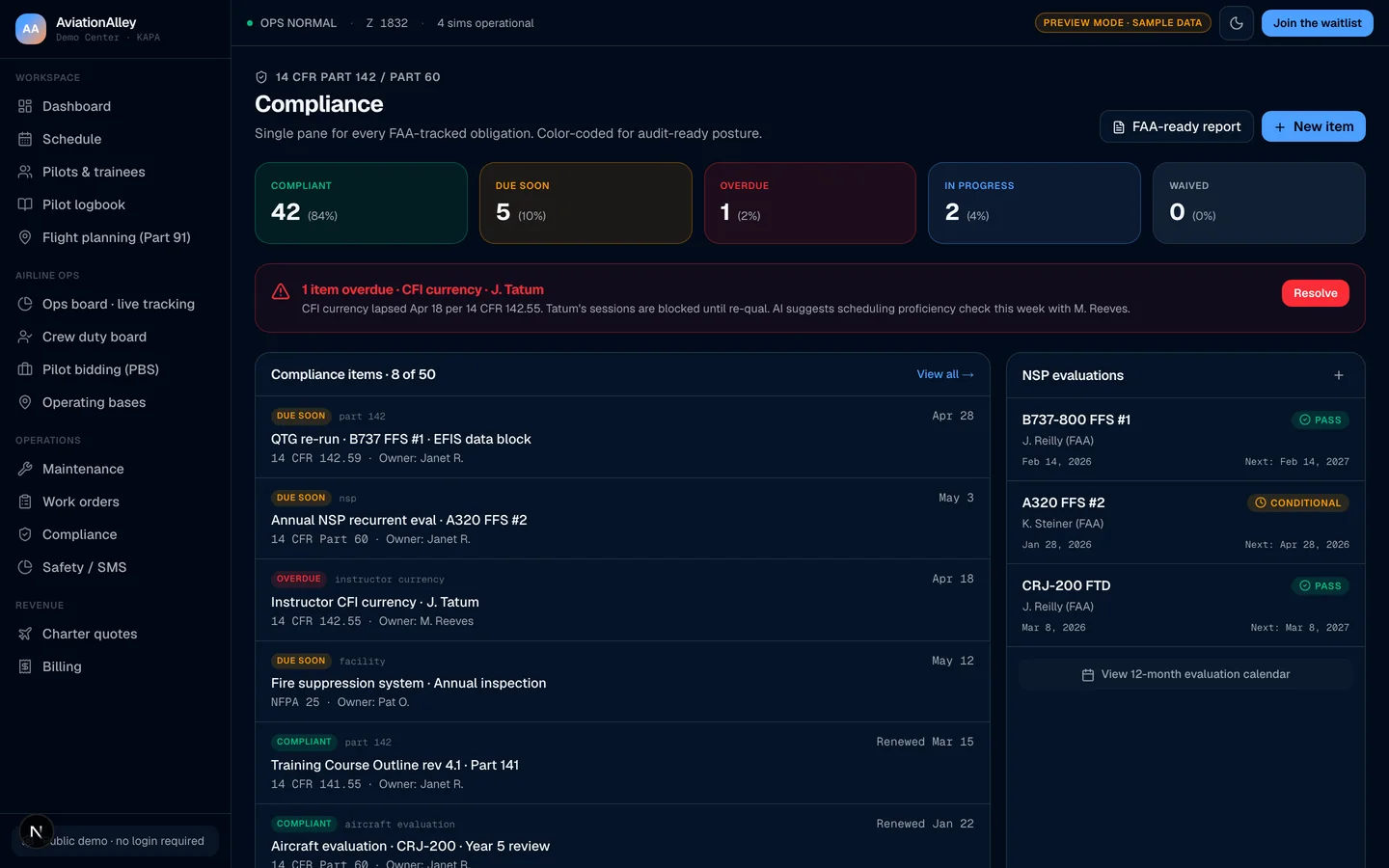
app.aviationalley.com/compliance
Rules engine, not a black boxLive
FAR 117, 121.467, FRAT, fatigue-risk, AOG-risk and airworthiness-due run on auditable line-by-line FAR rules.
Off by default, no surprisesLive
Every AI surface hides itself when no API key is set — no half-working features in demos or offline ops.
Feature deep dive
Ten features built
for FAA compliance.
From compliance records to Hobbs-based billing — every workflow an FAA-approved training center runs, purpose-built as connected requirements.
01 / 12
● Live
Part 142 compliance dashboard
Open items across all students, instructors, and simulator devices — visible in a single compliance dashboard. Curriculum approvals, check instructor qualifications, courseware version history, and FAA-required training records tracked continuously. Audit prep is an export, not a weeks-long scramble through binders and shared drives.
02 / 12
● Live
FAA curriculum & courseware tracking
Approved training programs and courseware versions live in the platform. Active and superseded versions are maintained automatically — no manual version log. The Part 142 requirement to keep a complete, current training program is a first-class data model, not a folder of PDFs someone updates by hand.
03 / 12
● Live
Student enrollment & training records
Enrollment, stage checks, endorsements, FAA logbook entries, and Practical Test Standards completion all live in one training folder per student. No binders. No disconnected spreadsheets. Export any folder as a complete, organized record set at any time — what the FAA wants to see is always there.
04 / 12
● Live
Check instructor qualification tracking
Check instructor currency, endorsements, and evaluation history stay current in the platform — not assembled by hand before an inspection. This is where Part 142 centers scramble hardest before an FAA audit. AviationAlley tracks it continuously, so the record is ready when the inspector shows up.
05 / 12
● Live
Simulator scheduling & utilization
Schedule full-motion and fixed-base simulators on a calendar that understands FSTD, FTD, and ATD designations, qualification levels, and maintenance windows. Double-bookings are eliminated. Every session records the device designation the FAA requires. Utilization is tracked per device, so capacity decisions run on data instead of guesswork.
06 / 12
● Live
Invoice aging + wire-transfer reconciliation
A billing hub shows invoice aging buckets (current, 30, 60, 90, 90+) next to the wire-transfer alert summary. Pending wires sit one click from the invoices they fund. Mark a wire received and link it to the open invoice — the client's aging adjusts automatically. Reconciliation lives where the receivable lives, not in a separate accounting export.
07 / 12
● Live
Role-based staff workspaces
Each of the 13 staff roles — from Owner, Manager, and Dispatcher to Sim Tech, Pilot, and Flight Attendant — sees only what their job needs. Dedicated pages for endorsements, session requests, and staff workload sit alongside the schedule and work-orders queue. FAA evaluators get time-limited, read-only auditor access that expires automatically — no background job, no forgotten credentials. Write access is gated to maintenance roles and above by default.
08 / 12
● Live
Client account management
Airlines, charter operators, Part 121/135 carriers, corporate flight departments, and Part 141 schools are tracked as named client accounts. Each client manager gets their own portal. It shows their pilots' training status, medical expiry alerts, and upcoming sessions — cleanly separate from the center's internal staff interface.
09 / 12
● Live
BSA/FinCEN-compliant wire transfers
International wire transfers ship with BSA/FinCEN compliance built in. Transactions of $10K or more auto-flag for CTR (31 CFR §1010.311). OFAC flags, 5-year retention reminders (31 CFR §1010.316), and the IRS Form 8300 notice are included. 20 currencies convert to USD at live rates, and wire references auto-generate in WT‑YYYY‑NNNN format.
10 / 12
● Live
Trainee-facing portal
Students get their own portal for training progress, upcoming sessions, history, and billing. It is a separate experience, not a shared login with a different homepage. Every view is built around what a student needs to see — not a pared-down version of the admin panel.
11 / 12
● Live
In-app notifications center
One read/unread feed surfaces what needs attention across the center: compliance flags, time-off requests, billing events, and session changes. No more scattered emails. Old notifications age out automatically on a retention schedule, so the feed stays current without becoming noise.
12 / 12
● Live
QuickBooks invoice bridge
Send a B2B client invoice straight to QuickBooks Online with one action. The bridge maps the invoice and client account into QBO, so your books stay reconciled without double entry. The receivable lives in AviationAlley with the training records. The accounting record lands in QuickBooks, where your bookkeeper already works.
Go deeper
A full breakdown of
every core feature.
Each part of the platform has its own deep-dive — what it does, how an FAA training center uses it, and the questions owners ask before switching. AviationAlley is pre-launch; these describe what the founding-cohort build is built to do.
Compliance & Records
Requirements on a Compliant→Due→Overdue timeline, TS document control, and one-click FAA audit export.
Read the deep-dive →Safety (Part 5 SMS) & FRAT
Four-pillar SMS, FRAT risk scoring, ASAP/hazard reporting, and a fatigue risk board.
Read the deep-dive →Pilot Bidding & Crew (Part 121)
LINE/PBS bidding, crew pairings, a duty board, reserve, and FAR 117 duty-rest legality.
Read the deep-dive →Pilot Logbook & Credentials
61.51 logbook with ForeFlight import, plus a credentials vault with expiry alerts.
Read the deep-dive →Simulator Scheduling & Utilization
Schedule FSTD/FTD/ATD devices and track utilization across your fleet.
Read the deep-dive →Charter Dispatch & Quoting
Charter quotes, dispatch trip-sheets, contracts, and Hobbs close-out billing.
Read the deep-dive →IRROPS Recovery & Cargo
Explainable legal re-crew and tail-swap recovery, plus cargo & ULD management.
Read the deep-dive →Maintenance, MEL & Fleet
Work orders, parts & POs, MEL deferrals, AD/SB import, and predictive maintenance.
Read the deep-dive →Hobbs-Time Training Billing
Log Hobbs time once — it flows to the training record and the invoice.
Read the deep-dive →B2B Client Accounts & Contracts
Invoice airlines, charter operators, and Part 141 schools by contract.
Read the deep-dive →Wire-Transfer Reconciliation
Reconcile international airline wires to the invoices they fund.
Read the deep-dive →QuickBooks Invoice Bridge
Push invoices to QuickBooks Online so your books stay current without double entry.
Read the deep-dive →Client, Owner & Trainee Portals
Branded portals for client orgs, charter customers, aircraft owners, and trainees.
Read the deep-dive →Role-Based Staff Workspaces
Scoped roles per job, plus time-limited read-only access for FAA auditors.
Read the deep-dive →Developer API & Webhooks
A scoped REST API, HMAC-signed webhooks, Slack/Teams, and a QuickBooks bridge.
Read the deep-dive →A closer look
Tour the rest
of AviationAlley.
Six more screens — the marketing surfaces, the per-state regional pages, the security & trust page for B2B due diligence, and the operator signup flow.
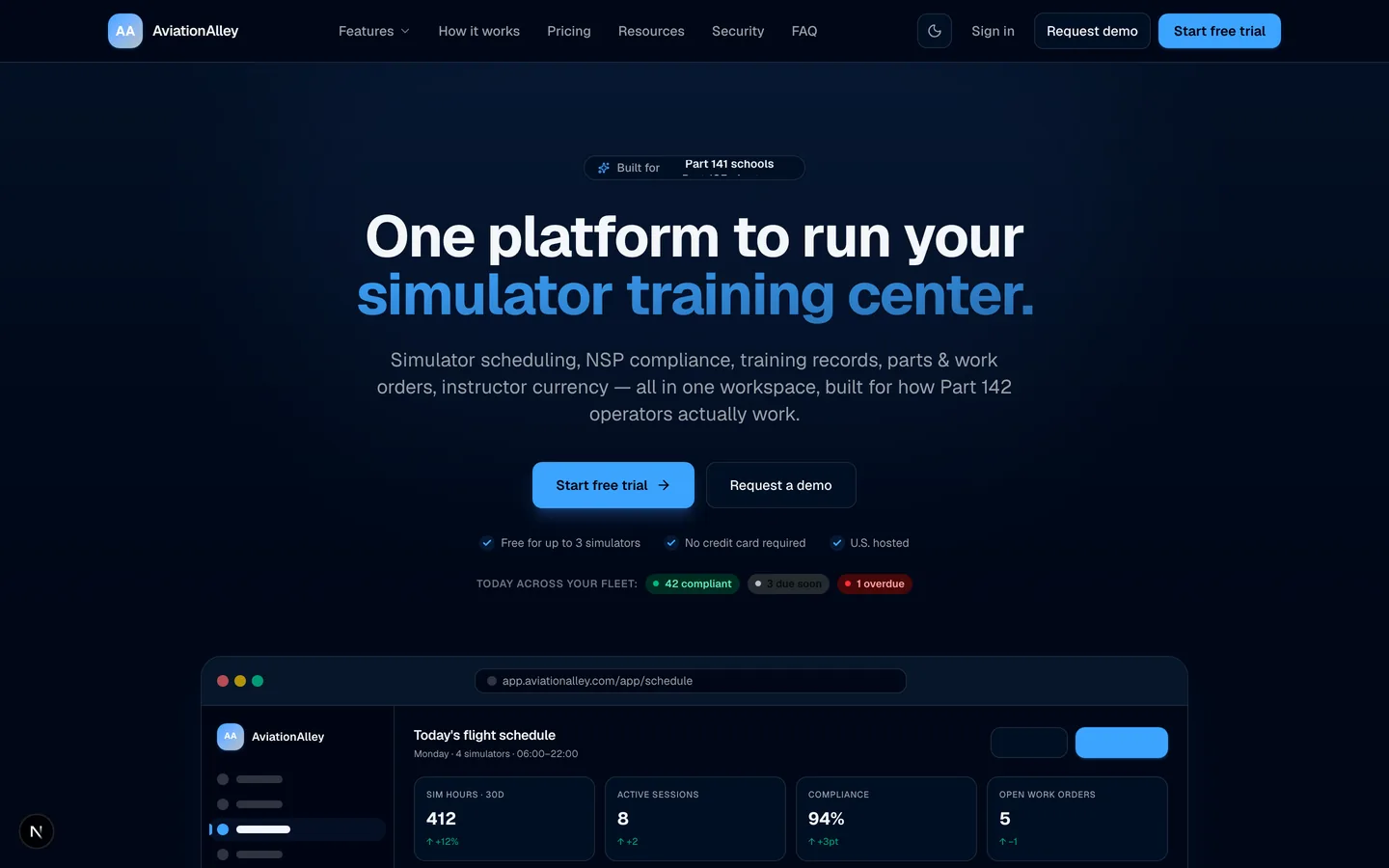
Multi-vertical aviation-ops software — built around the compliance, crew, dispatch, and B2B billing realities of training centers, charter, and airline operators.
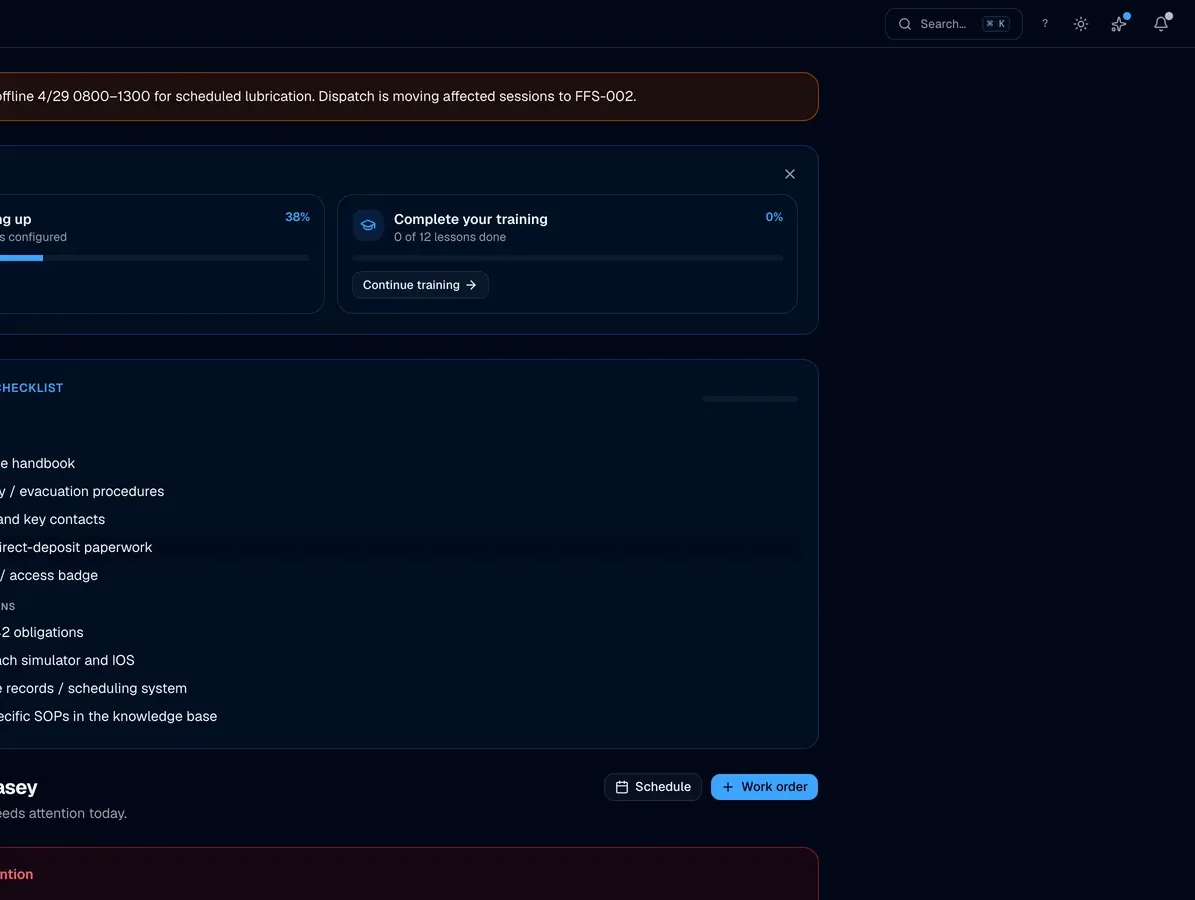
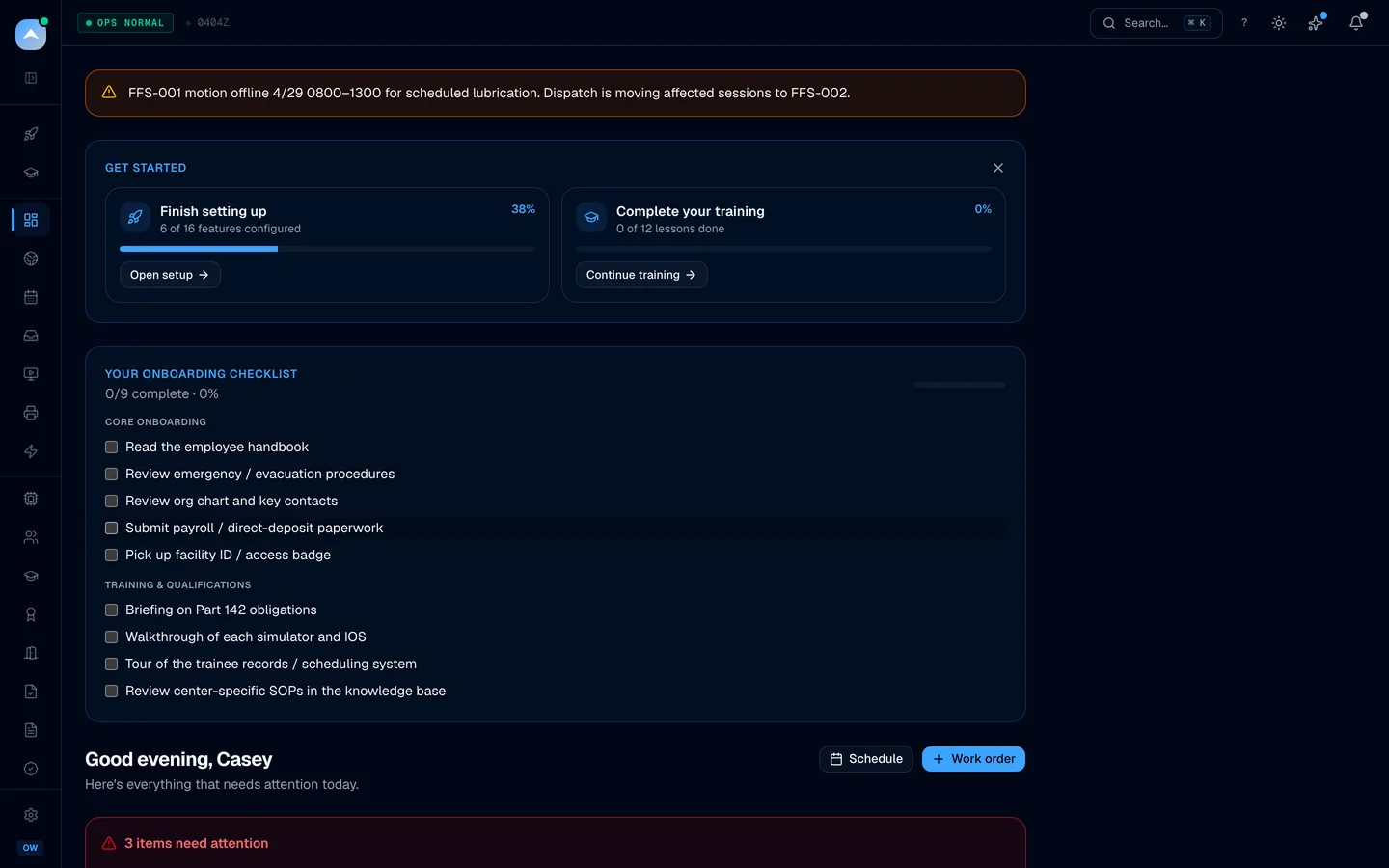
The live operations view an aviation operator opens every morning — today's schedule, compliance and crew-duty flags, and work-order status at a glance.
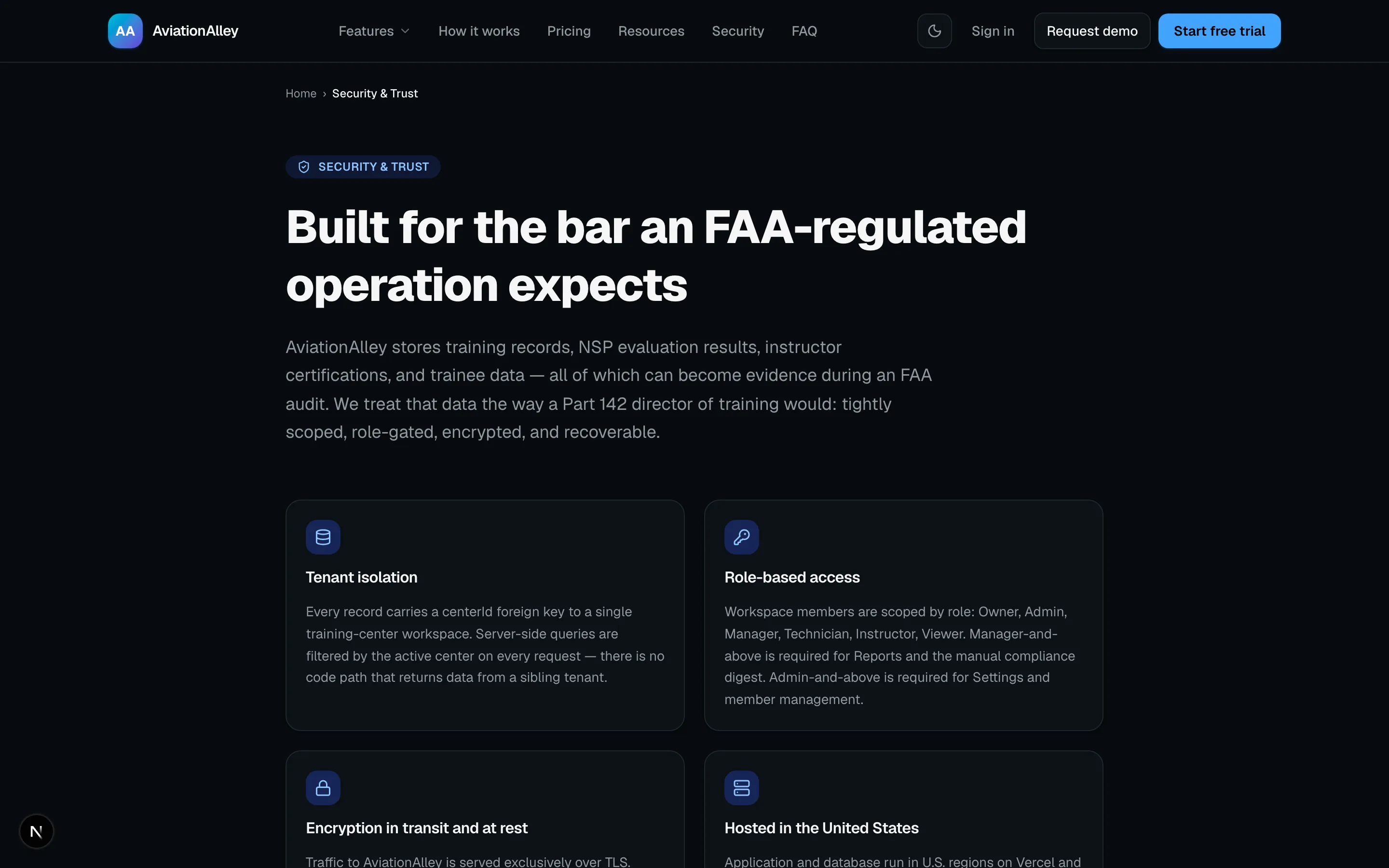
Tenant isolation, RBAC, encryption, operational practices, vuln-disclosure policy — ready for B2B procurement reviews.
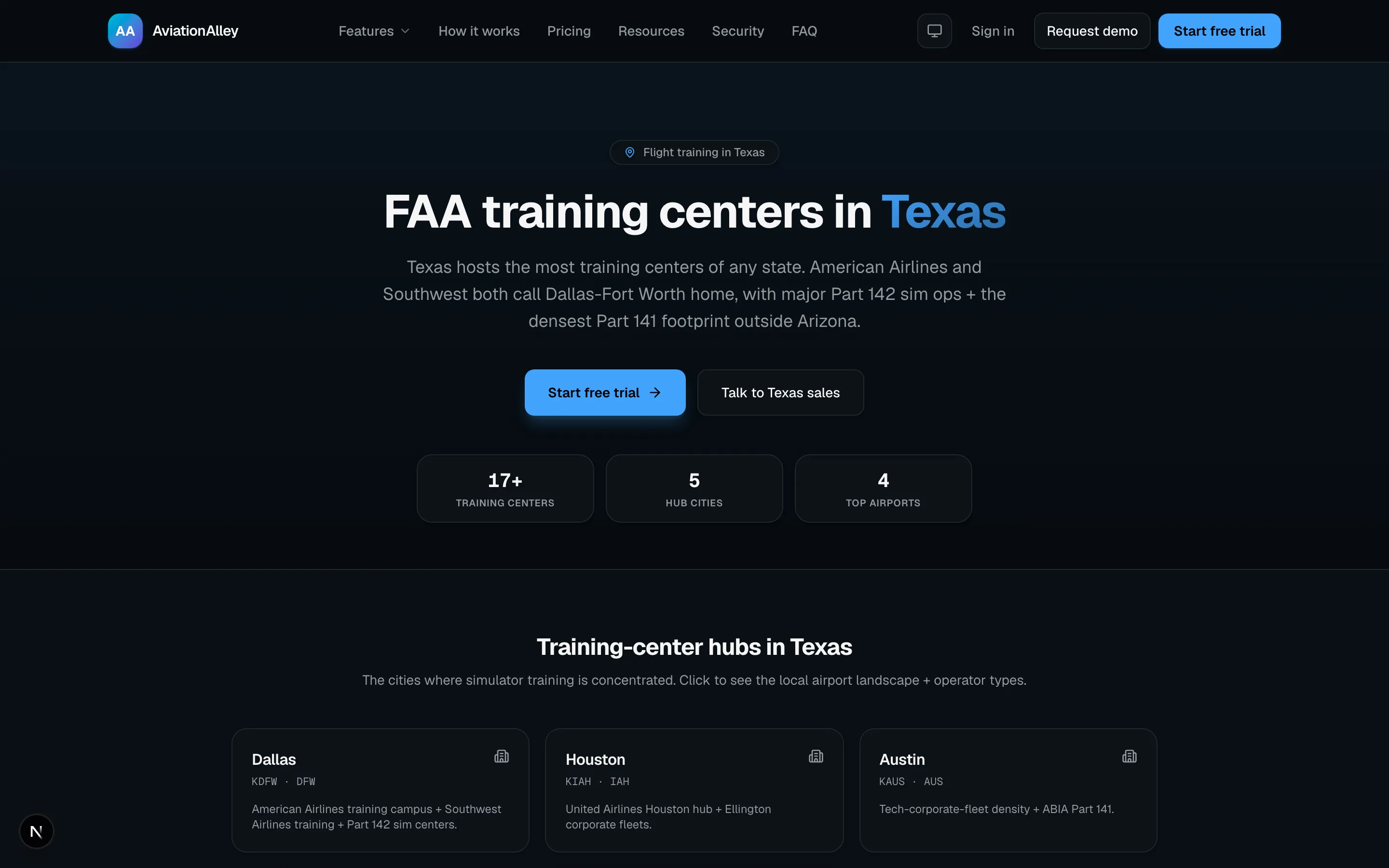
Per-state landing pages with hub-city callouts (DFW, Houston, San Antonio) and FAA-compliant copy for local SEO.
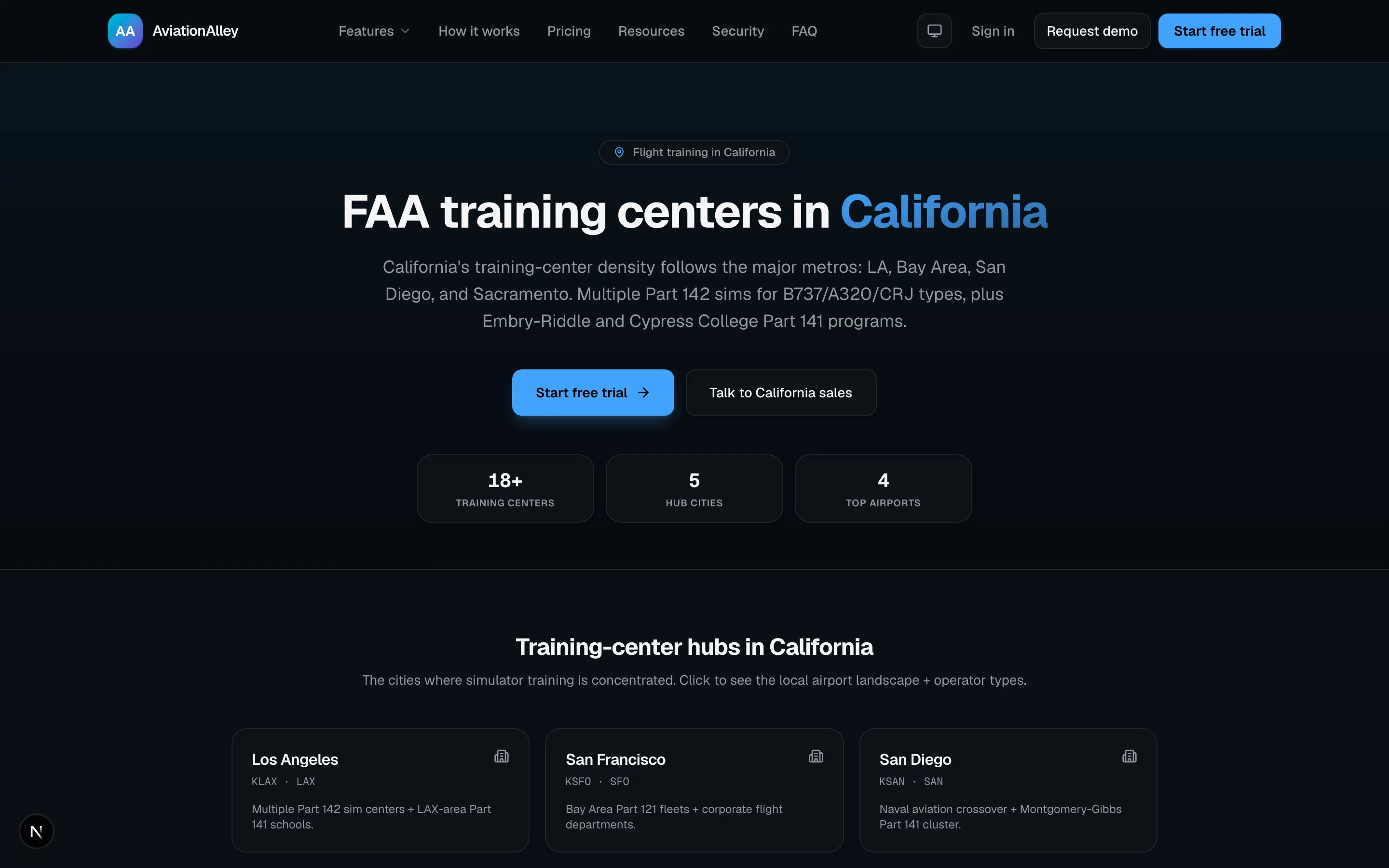
10 states currently pre-rendered with state-specific FAA messaging. Easy to expand to all 50.
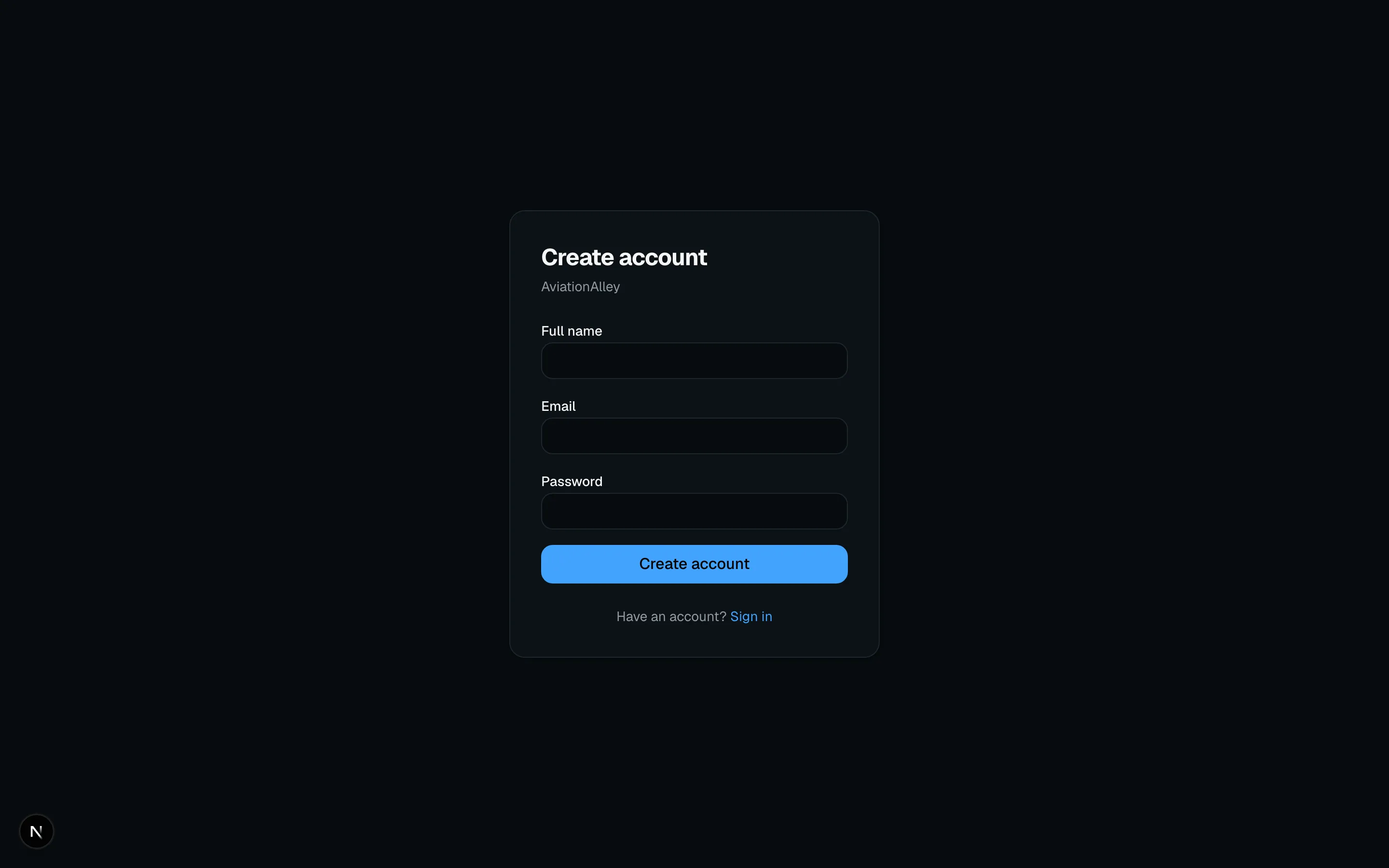
Founding-cohort signup flow. Aviation operators can apply directly to be in the early-access wave.
The problem
FAA flight schools and training centers run on
disconnected tools and binders
FAA-approved training centers have the most demanding compliance requirements in aviation training — and the least purpose-built software to meet them.
Compliance records
Curriculum approvals, courseware versions, and check instructor records live in spreadsheets, binders, or a shared drive someone updates by hand. FAA audit prep takes days.
Simulator scheduling
Simulators get booked on a generic shared calendar. It knows nothing about device type, qualification level, or maintenance windows. Double-bookings happen, and utilization is invisible.
Student & instructor records
Enrollment, stage checks, endorsements, and FAA logbook entries sit in binders, spreadsheets, and systems that don't talk to each other. No one has a single source of truth for a student's training status.
Billing
Invoices get built from estimates instead of actual logged Hobbs time. Every billing cycle, someone reconciles flight records, simulator logs, and the accounting system by hand. Hours get missed. Disputes happen.
How it works
Built around how
FAA operations actually run.
AviationAlley is designed around the compliance, scheduling, and billing realities of an FAA-approved training center — not adapted from generic school management software.
1
Configure your ATO
Set up your approved training organization — simulators by device type and qualification level, instructors, curriculum packages, and Part 142 compliance requirements. Takes hours, not weeks.
2
Run daily operations
Enroll students, schedule simulators and instructors, log Hobbs time, capture endorsements and stage checks, and record FAA-required training documentation — all in one platform, connected by design.
3
Audit-ready, always
Curriculum approvals, courseware versions, check instructor qualifications, and student training records organized and exportable at any time. The next FAA inspection is not a weeks-long scramble — it's a button.
One platform, every Part
Built to run an entire
FAA operation — from one system.
Part 142 is the core today. AviationAlley is built to run every FAA Part a training, flight, charter, or maintenance operation lives under — on one platform, opening Part by Part.
What’s built
Everything that’s built
— one platform, every Part
AviationAlley is built and opening to a founding cohort, Part by Part. Here is what each FAA operation runs inside the platform — compliance records, scheduling, training records, and billing, purpose-built per Part instead of bolted onto a generic tool.
- Crew currency, recurrent training, and qualification records in one place.
- Aircraft scheduling, squawks, and maintenance-status visibility.
- Compliance and document storage for inspections and insurance.
- Internal cost allocation and chargeback across departments or owners.
- Crew qualification, currency, and recurrent-training tracking against ops-spec requirements.
- Trip and aircraft scheduling with crew-legality awareness.
- Training and checking records kept inspection-ready.
- Client and charter billing, including B2B accounts.
- Approved curriculum and syllabus versioning with stage-check tracking.
- Student enrollment, progress, and graduation records, audit-ready.
- Aircraft, simulator, and instructor scheduling.
- Tuition and training billing, including financed and on-account students.
- FSTD / FTD / ATD qualification-aware scheduling.
- Curriculum approval state and versioning; check-instructor qualification tracking.
- B2B billing on client accounts — airlines, charter, corporate flight departments, Part 141 schools.
- International wire reconciliation (SWIFT/UETR), multi-currency invoicing, and audit-ready exports.
- Technician certification, training, and authorization records.
- Capabilities list and rating documentation kept inspection-ready.
- Work-order and compliance recordkeeping.
- Customer billing on account for maintenance work.
- Student enrollment, progress, and graduation records.
- Curriculum and competency tracking against ACS-based standards.
- Attendance and instructor records, audit-ready.
- Tuition and program billing, including financed students.
FAA compliance, first-class
Every compliance requirement
built in from day one
Most training software treats Part 142 requirements as edge cases or checkbox fields. AviationAlley is architected around them — simulator scheduling, check instructor qualifications, and curriculum version control are core features, not add-ons.
- Curriculum approval tracking — active and superseded courseware versions maintained automatically, no manual version log
- Check instructor qualification records — currency, endorsements, and evaluation history in one place and always current
- Simulator qualification level and device type tracked per booking — FSTD, FTD, and ATD recorded on every session
- FAA-required training records: logbook entries, endorsements, stage checks, and Practical Test Standards completion
- Student training folders audit-ready at any time — exportable as a complete, organized record set
- Compliance dashboard showing open items across all students, instructors, and simulator devices
Part 142
Not a checkbox — an architecture decision
Part 142 compliance is baked into the data model from the start. Simulator sessions, training records, and curriculum documents are first-class objects. They are not custom fields layered onto a generic scheduling tool.
One click
FAA audit preparation
Because compliance records are maintained continuously in AviationAlley, audit prep is an export — not a weeks-long scramble through binders and shared drives. The records are always there, always complete.
Zero binders
Required after setup
Every document the FAA wants to see lives in AviationAlley — curriculum approvals, check instructor sign-offs, student training records. Physical binders become a backup, not the system of record.
Scheduling and B2B billing, connected
Hobbs time logged once.
Billed to the right client. Reconciled to the wire.
Part 142 centers don't bill students — they bill airlines, charter operators, corporate flight departments, and Part 141 schools. AviationAlley is built for that reality. Hobbs time rolls up to a named client account. Invoices age against that account. International wires reconcile back to the invoices that funded them.
- Simulator scheduling with device type, qualification level, and maintenance window awareness — no more booking an unavailable sim
- Aircraft scheduling with Hobbs start/end logging tied directly to the trainee training record
- Instructor scheduling with conflict detection across simulators, aircraft, and ground sessions simultaneously
- Client accounts for airlines, charter operators, Part 121/135 carriers, corporate flight departments, and Part 141 schools — pilots roll up to the org that pays for their training
- Invoice aging buckets (current, 30, 60, 90, 90+) with the wire-transfer alert summary right on the billing hub
- International wire transfer queue: SWIFT/UETR references, 20 currencies with live USD conversion, BSA/FinCEN CTR and OFAC flags, 8-state lifecycle from INITIATED to APPLIED
B2B
Built for who actually pays the bill
Consumer-checkout-style billing is the wrong model for an ATO. Real Part 142 revenue comes in as international wires from airlines and corporate flight departments — so client accounts and wire reconciliation are the billing primitives, not card-on-file.
SWIFT/UETR
Wire references and FinCEN compliance built in
CTR auto-flags transactions ≥ $10K (31 CFR §1010.311), OFAC review fields, IRS Form 8300 notice, and 5-year retention reminders (31 CFR §1010.316). Wire references auto-generated in WT‑YYYY‑NNNN format on every transfer.
One queue
Received wires reconciled against open invoices
The wire-transfer queue and the invoice ledger share the same view. Mark a wire received, link it to the open invoice it funded, and the client's aging drops automatically — no separate accounting export to keep in sync.
How it stacks up
AviationAlley vs. how
training centers operate today
Generic CRM and scheduling tools weren’t built for FAA compliance. Paper binders don’t scale. AviationAlley is the first platform purpose-built for FAA training centers and operators — Part 142 first.
| Capability | AviationAlley | Legacy training mgmt software | Generic CRM & school apps | Paper & binders |
|---|---|---|---|---|
| Built for Part 142 compliance | ✓ | Partial | — | — |
| Simulator scheduling & utilization | ✓ | Partial | — | — |
| Student enrollment & progress tracking | ✓ | ✓ | Customizable | Manual |
| FAA-required logbook entries & endorsements | ✓ | Partial | — | Manual |
| Curriculum & courseware version control | ✓ | Partial | — | Binder |
| Check instructor qualification tracking | ✓ | — | — | — |
| B2B client accounts (airlines, charter, corporate, Part 141) | ✓ | — | Custom CRM | Manual |
| International wire reconciliation (SWIFT/UETR, multi-currency) | ✓ | — | — | Spreadsheet |
| BSA/FinCEN compliance (CTR, OFAC, Form 8300, 5-year retention) | ✓ | — | — | Manual |
| Hobbs-time logging tied to training records | ✓ | Partial | — | Manual |
| Setup time for a typical operation | Days | Weeks | 6–12 months | — |
What's built
Built across
every FAA operation.
AviationAlley is built across training, charter, corporate, and maintenance — Part 61 through 147. Everything below is in the platform today, built with operators from day one.
Built
Part 142 compliance core
- FAA-approved curriculum & courseware tracking
- Check instructor qualification records
- Student enrollment & training records
- FAA logbook entries & endorsements
- Compliance dashboard & audit export
- Founding cohort onboarding
Built
Scheduling & billing
- Simulator scheduling (FSTD, FTD, ATD)
- Aircraft scheduling with Hobbs logging
- Instructor scheduling & conflict detection
- Automated Hobbs-based invoice generation
- Student payment portal (ACH, card, Apple Pay)
- Utilization dashboards by device & instructor
Built
Advanced operations
- Multi-ATO management
- API integrations with existing TMS platforms
- Advanced analytics & capacity forecasting
- Regulatory change tracking & compliance alerts
- Mobile app for instructors & students
- Stage check & checkride scheduling workflows
Founding cohort
The first ATOs in
build the compliance layer.
AviationAlley's founding cohort is Part 142 training centers actively using the platform and encoding their real compliance workflows into the product before public launch.
Request founding access01
Founding-cohort access
Be one of the first operators on the platform — direct access to the team and a roadmap shaped around how your operation actually runs.
02
Your ATO's compliance requirements built in
Every Part 142 ATO has specific curriculum structures and record-keeping workflows. Founding centers' requirements become part of the core product — not custom fields.
03
Direct access to the team
No support queues. Founding members have a direct line to the engineers. FAA compliance edge cases get solved at the platform level, not patched with workarounds.
04
Records migration support
We help migrate your existing student training records, curriculum documentation, and instructor qualification files. You go live with your real data — not a blank slate.
Common questions
Things FAA operators ask us.
What is AviationAlley?
AviationAlley is an operations platform purpose-built for FAA Part 142 approved training centers. It covers the full operational lifecycle — student enrollment and progress tracking, simulator and instructor scheduling, FAA-compliant training records, curriculum version control, Hobbs-based billing, and student payments — in one connected platform.
Who is AviationAlley for?
AviationAlley is built specifically for Part 142 approved training centers — the directors, chief instructors, schedulers, and administrators who manage FAA-approved simulator training programs. If you run an ATO with FSTD, FTD, or ATD devices and the compliance burden that comes with Part 142 approval, AviationAlley is built around your operation.
How does AviationAlley handle Part 142 compliance records?
AviationAlley maintains curriculum approval status, courseware version history, check instructor qualifications, and student training records as first-class data — not custom fields in a generic tool. Every FAA-required document is stored, versioned, and exportable at any time. Audit preparation becomes an export, not a scramble.
How does simulator scheduling work in AviationAlley?
AviationAlley schedules simulators with awareness of device type (FSTD, FTD, ATD), qualification level, and maintenance windows. It detects conflicts across instructors, students, and devices simultaneously. Every session is tied to the student training record and drives billing automatically from logged Hobbs time — no manual transfer between systems.
How does AviationAlley handle Hobbs-based billing?
Hobbs time is logged directly in AviationAlley when a simulator or aircraft session is completed. That time drives the invoice automatically — simulator rates, aircraft rates, and ground instruction billed at the correct rates without manual entry or reconciliation. Invoices go to the student portal for ACH, card, or Apple Pay payment.
Is AviationAlley different from ForeFlight or Garmin Pilot?
Yes — completely different product category. ForeFlight and Garmin Pilot are cockpit tools for pilots. AviationAlley is a business operations platform for the training center running the program — scheduling, compliance records, student management, and billing. Different problem, different user, different platform.
Does AviationAlley replace a training management system (TMS)?
Yes, for Part 142 training centers. AviationAlley handles student enrollment, curriculum tracking, FAA-required records, simulator scheduling, instructor management, and billing in one platform. It replaces the patchwork of a scheduling tool, a records binder, a billing spreadsheet, and a generic LMS that most ATOs are running today.
When will AviationAlley launch?
AviationAlley is in active development. Early access is opening to a founding cohort of Part 142 training centers. Check roffik.com/aviationalley/ or use the contact form to get in the queue.
What software do Part 142 training centers use today?
Most Part 142 ATOs today run a combination of a generic scheduling tool (Google Calendar, Aero Manager), a training records binder or spreadsheet, a separate billing system, and manual FAA compliance tracking. AviationAlley replaces all four with one platform built around the specific compliance and scheduling demands of a Part 142 operation.
How does AviationAlley compare to Aero Manager or other aviation school software?
Aero Manager and similar tools were designed primarily for Part 61 flight schools — aircraft scheduling, instructor booking, and student records. They handle Part 142 compliance as an add-on, not a foundation. AviationAlley is architected from day one around Part 142 requirements: curriculum version control, check instructor qualification tracking, FSTD/FTD/ATD scheduling with qualification awareness, and Hobbs-connected billing.
Keep reading
Go deeper on aviation operations
Answers
Bill airlines for Part 142Schedule sims by qual levelPart 142 audit prepReconcile a wire to an invoiceMigrate Part 142 recordsQuote & bill a charter tripHEMS Part 135 softwareFAR 117 legality checksPilot credential trackingIRROPS re-crew & tail swapsFree tools
Part 142 currency converterGet early access to AviationAlley
AviationAlley is built with operators from day one. Join the founding cohort to get in first and help shape the roadmap before public launch.